
Lichens
Notes by Isobel Clark
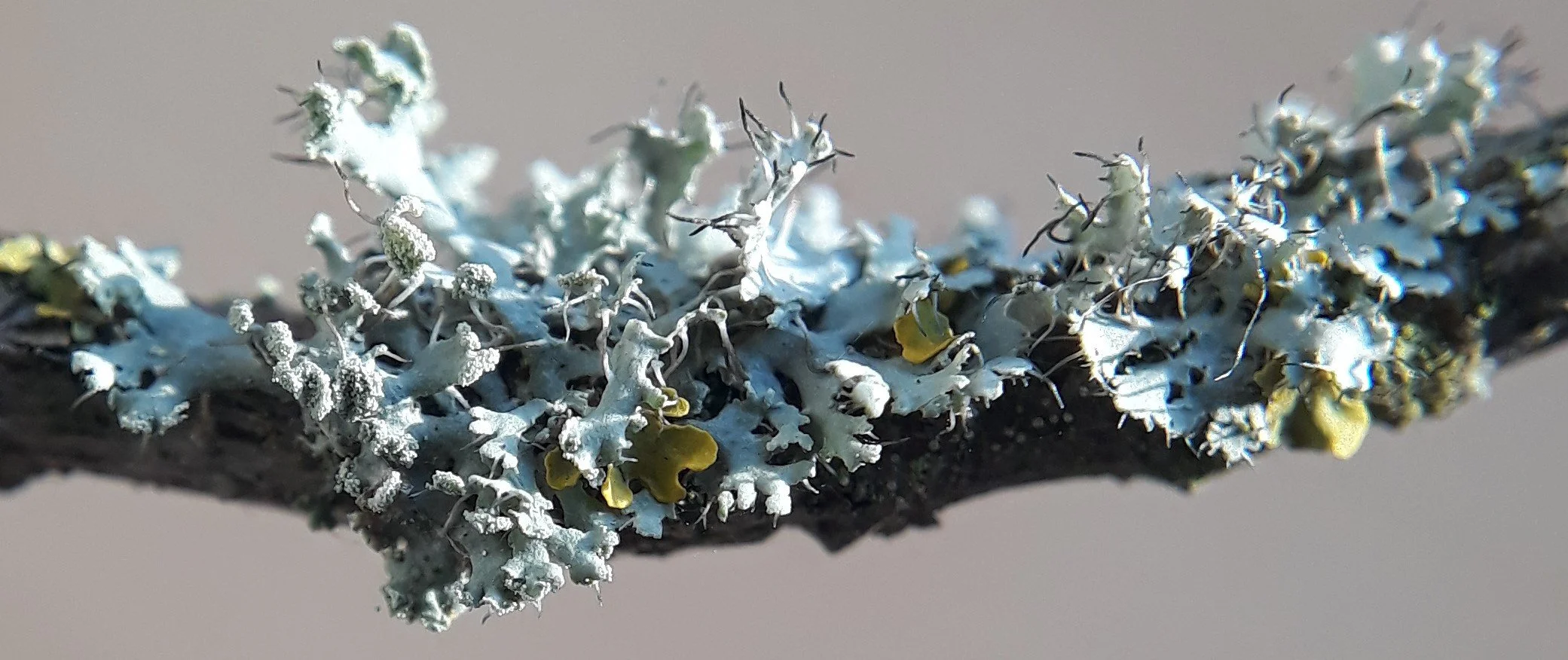
Physcia tenella (Fringed Rosette lichen)
For a lifeform that is so widespread on Earth, lichen is an expert at hiding in plain sight. If you go out of your front door you will be within a few metres of a number of common ones and yet, you may not see them. They can be found anywhere in the world, on all continents, even Antarctica where some grow inside the rock.
They can be found growing on almost any substance if it stays around for long enough as lichens mostly grow slowly. The most common substrates are trees and rocks but they can also be found on worked wood or stone, soil, concrete, bricks, metal, glass, asphalt, plastic, bone, fabric, rope, rubber as well as plants, other lichens and even animals. Some don’t even need a substrate and travel around by rolling up when they are dry and getting blown by the wind until they come to a damper place where the moisture makes them unroll and lie flat. Mostly they grow on the surface of the substrate but some are found inside rocks. In some cases the only part that is visible is the fruiting body when it reproduces, rather like mushrooms being the visible fruiting body of the fungus which is mostly inside the soil or wood or other decaying substance.
They grow in all climates from the hottest to the coldest and from the driest to the wettest, and everywhere in between. As the nutrients for the lichen come from photosynthesis by the algal partner and from the atmosphere, they need light to survive and so are more frequently found in well-lit situations. Having said that they can tolerate very low light levels such as those in some caves but there they grow slowly and are not abundant. They also need carbon dioxide to photosynthesise, and water, so they have a mechanism where they can shut down if they dry out or there is insufficient carbon dioxide. They have even been shown to be able to survive the rigours of outer space. In an experiment on the International Space Station two lichens were attached to the outside for 18 months after which they were found to have survived the combined effects of intense solar radiation, including UV and X-rays, hundreds of degrees both below and above freezing, and the complete absence of any gases.
They have played a crucial role in the establishment of life on this planet as they are among the first things to grow on rock and play a significant part in its breakdown into soil. Having been around for 400 million years or more, they can afford to take their time and some grow at a rate of only 1mm in 100 years. Having said that, most of those found in the UK grow at between 0.1mm and 10mm per year.
They are used by a wide variety of other lifeforms. There are moths and lacewings which use them for camouflage and birds that use them for nesting materials. They are a whole habitat in their own right for the smallest creatures and provide food for many animals, from invertebrates to large mammals like reindeer. In fact, without lichen there is a whole culture which would not survive, one which depends on the herding of reindeer; that is the Sami of northern Scandinavia. Humans use lichens for dyeing, brewing, and monitoring air pollution. In the nineteenth century, lichens became so valuable that they were more costly than rare spices. We have used them for medicine, poison, and for making perfume since the 12th century, if not before. And lichen is the material used to make that indicator you may remember from chemistry lessons, called litmus.
If after all this, you would like to see some lichen or find out more about them, a good place to start is the website of the British Lichen Society (britishlichensociety.org.uk).
And see Isobel’s photographs of some of the Lichens to be forund on the Commons here.
Lichens consist of at least two organisms growing together, a fungus and either an alga or a cyanobacteria. There are three main groups:
‘Crusty’ lichens are found on all kinds of surfaces, from stone, brick, tile and metal to worked wood and live bark. They grow very slowly and are attached to the surface so strongly they cannot be removed without taking some of the substrate to which they are attached. Fuscidea lightfootii – a crusty lichen (photo by Isobel Clark)
‘Bushy’ lichens are found mostly on bark, and grow from a single point of attachment known as a holdfast. These are sensitive to nitrogen and sulphur dioxide pollution so usually only grow in very clean air where there is no fertilising of crops, burning of coal or lots of traffic.
So it is encouraging that I have found a few examples of Usnea on the Commons as well as several examples of other bushy lichens.
‘Leafy’ lichens mostly grow on bark and wood but can sometimes be found on stone. They are attached at many points underneath but can usually be removed without taking any of the substrate. They vary in colour from grey through green to yellow and orange. One of the most common ones I’ve found, near to roads and arable fields, is Xanthoria parietina which is orange when it is in the sun and greyish when in the shade. There’s so much of it beside the road that you can see it from quite a distance. This one seems to thrive near sources of nitrogen pollution.
On our Commons, the lichens which are most sensitive to pollution seem to be particularly numerous on old hawthorn trees growing either in hedges or woodland edges where they have been well-lit for decades. Areas that are particularly well-endowed are the scrub areas beside the bottom ride and in one place beside Horseblock Lane.
If we can conserve these habitats, away from roads and arable fields, we should be able to support communities of these ancient and symbiotic life-forms which give us an indication of pollution levels and contribute to the absorption of CO2, possibly helping to slow climate change.
Protecting our Lichens, care when collecting:
Lichens are very slow growing and easily damaged. Any that are attached to substrates should not be removed but anything that has fallen to the ground (and which had obviously been growing at a greater height) is fair game and can be collected. So, for instance, a twig or branch that has fallen to the ground and which has a lichen of interest can be picked up and taken home, but a lichen growing on a twig of a living tree should be left in place. Lichens on gravestones, boundary, pudding or Jubilee stones should not be removed.